I Can't Write Past a Bad Sentence
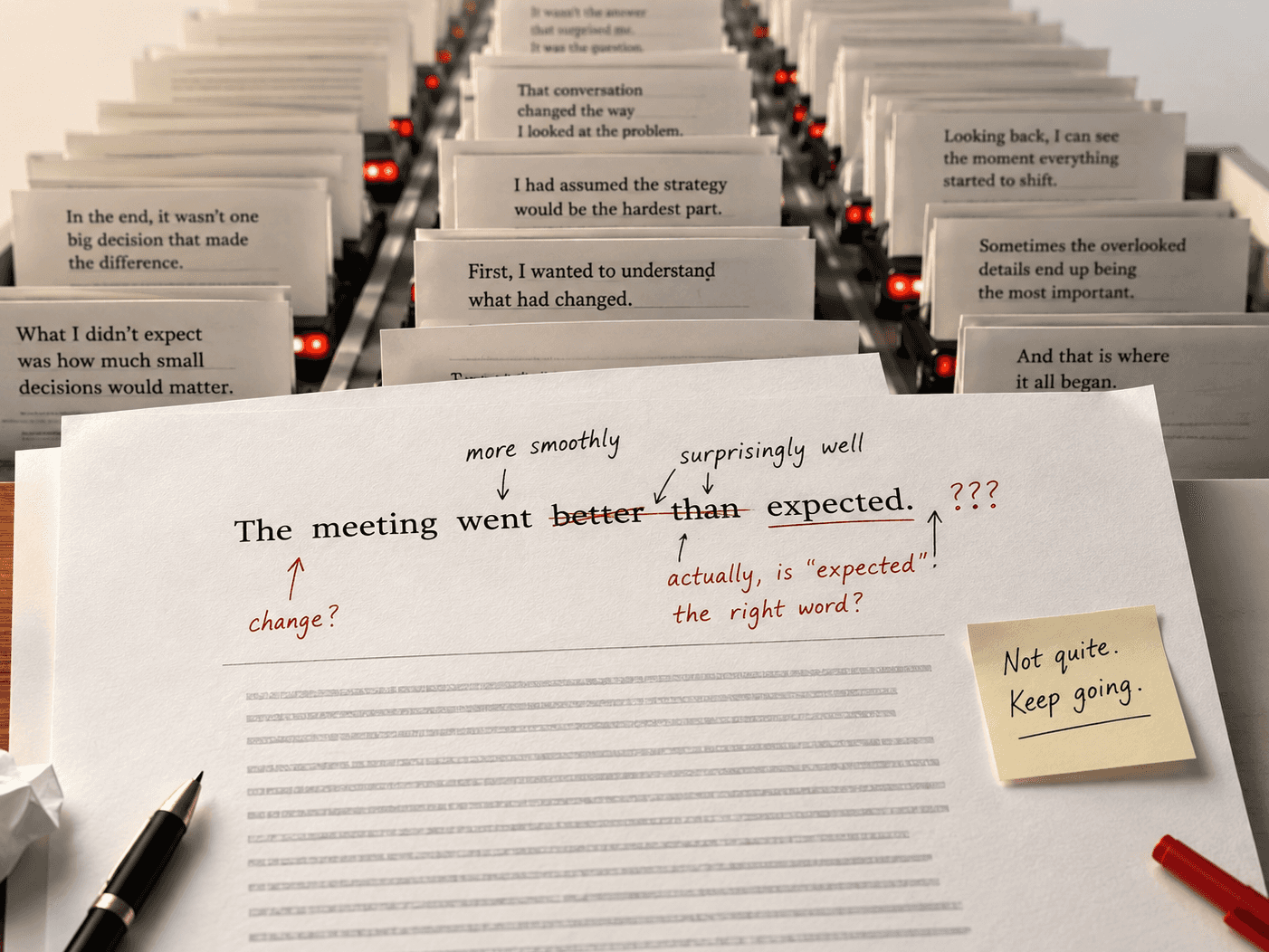
“Write now, edit later” has to be one of the most overrated pieces of advice I’ve ever gotten. What do you mean, "just get the first draft down"?
Apparently, you're supposed to silence your inner editor, keep writing, and trust that you'll fix everything later. They say it’s the formula that works for countless writers. Clearly, I am the odd one out, because I cannot get past that one sentence until it reads and sounds just right.
I just can’t. I have tried.
Sometimes it's a word, sometimes a rhythm. Sometimes it's because I've realised I'm trying to say something I don't fully understand yet. So, I’ll sit with it. Mull over it. Turn it around in my head a few times. Write it. Scratch it out. Rewrite it.
Does it slow me down? A little.
I know people who effortlessly produce thousands of words in a single sitting, only to edit them afterwards. I really admire that. But if I were to do the same, I’d find myself stuck somewhere around paragraph two, itching to scroll back up because I'd know something didn’t fit the way it was supposed to. It would bother me enough that the rest of the piece would become background noise until I fixed it.
I've learnt not to fight it. It's simply how my brain works.
But here’s the thing, writing is a deeply personal form of expression for me. It’s what allows me to translate a thought into language without losing what made the thought interesting in the first place. So if the words I put down on the virtual paper aren’t accurately reflecting the thought or feeling I wish to express, they’re meaningless.
And finding meaning for your words doesn’t always come easy.
You see, thoughts don't arrive in complete sentences. They're a hodgepodge of observations, feelings, half-formed ideas and tiny connections that somehow make perfect sense in your head. The difficult part is finding the sentence that gives someone else the same experience you had when the thought first occurred to you.
That's why I care just as much about how something sounds as what it says. I read almost everything out loud.
Not because I'm checking for grammar, but because the writing needs to have a rhythm. You can hear when a sentence is trying too hard. You can hear when a word doesn't belong. Sometimes the meaning is perfectly fine, but the sentence still refuses to settle because it doesn't flow the way it should.
It's a strange thing to explain to people who don't write.
"What's wrong with it?" they'll ask.
And the only answer I can honestly give is: "It just isn't right yet."
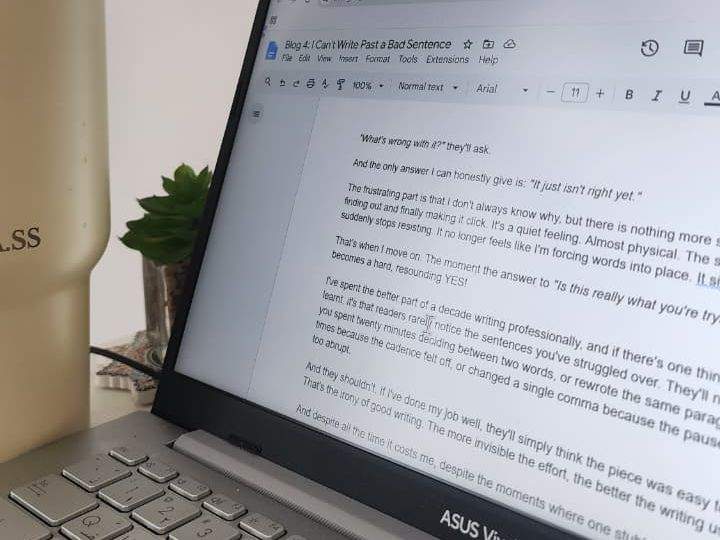
The frustrating part is that I don't always know why, but there is nothing more satisfying than finding out and finally making it click. It's a quiet feeling. Almost physical. The sentence suddenly stops resisting. It no longer feels like I'm forcing words into place. It simply... fits.
That’s when I move on. The moment the answer to "Is this really what you're trying to say?" becomes a hard, resounding YES!
I've spent the better part of a decade writing professionally, and if there's one thing I've learnt, it's that readers rarely notice the sentences you've struggled over. They'll never know you spent twenty minutes deciding between two words, or rewrote the same paragraph three times because the cadence felt off, or changed a single comma because the pause sounded too abrupt.
And they shouldn’t. If I've done my job well, they'll simply think the piece was easy to read. That's the irony of good writing. The more invisible the effort, the better the writing usually is.
And despite all the time it costs me, despite the moments where one stubborn sentence refuses to cooperate, I wouldn't change the way I write. Because every time I finally land on the sentence I'd been searching for, I get the same feeling.
The one that quietly says,
"There you are."